
Understanding the Tap Changer in Power Transformers
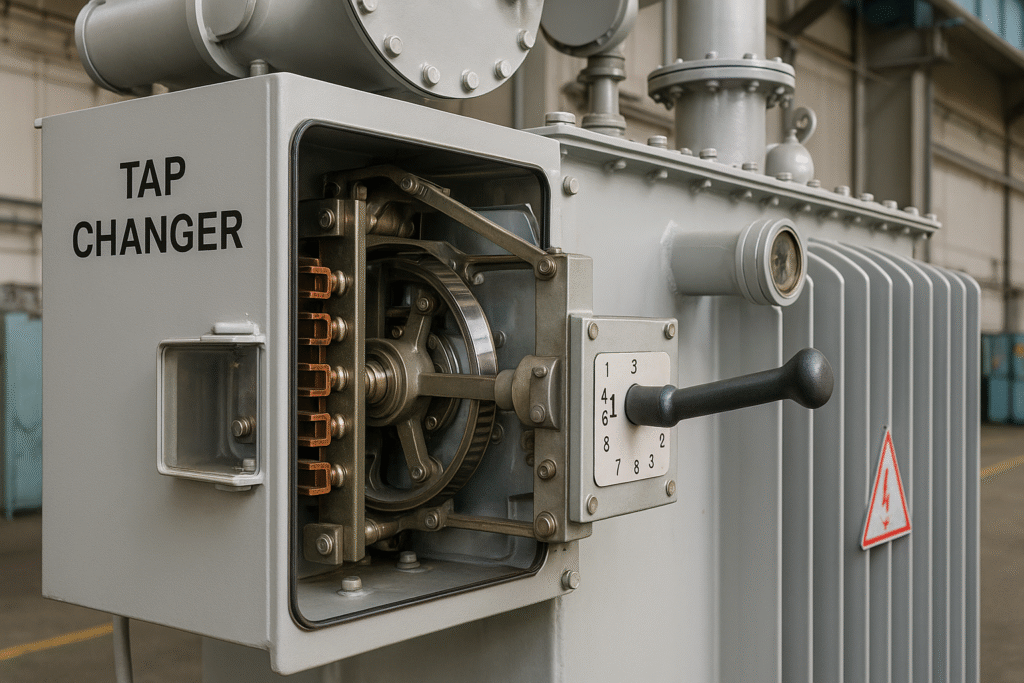
Introduction
One of the fundamental equations governing transformer operation is:
Voltage = 4.44 × Flux × Frequency × Number of Turns
As you can see, the number of turns is directly proportional to the voltage. This means we can control the voltage value by adjusting the number of turns.
The Importance of Voltage Regulation in Transformers
In a transformer, the secondary side is connected to loads, and these load voltages are supposed to remain stable. You also know that the voltages on the primary and secondary sides follow a ratio determined by the number of turns in each winding.
Under any condition, if the voltage increases on the primary winding, the voltage on the secondary winding connected to the loads will also increase. This can lead to damaging or burning out devices and equipment.
Therefore, to stabilize the voltage on the secondary side, we use a device called a Tap Changer.
Purpose of the Tap Changer
The main goal of the tap changer is to regulate the output voltage of the power transformer and maintain voltage stability. It achieves this by switching between different turns on the high-voltage (primary) winding of the transformer.
By changing the number of active turns, the turn ratio is adjusted, which in turn allows us to control the output voltage.
✅ The tap changer is a mechanical device.
Types of Tap Changers
Tap changers are divided into two main types:
1️⃣ Off-Load Tap Changer
- Also known as off-load tap changer.
- Used in small transformers, such as distribution transformers.
- Tap positions can only be changed when the transformer is completely de-energized (switched off from both sides).
- This is done to avoid sparking during the switching process since it doesn’t have its own arc-quenching tank.
- The tap change mechanism is located inside the bushing, making it inaccessible unless the transformer is switched off.
2️⃣ On-Load Tap Changer
- Used in large power transformers.
- Allows changing tap positions while the transformer is operating normally (under load).
- Equipped with an independent tank to quench any arcs during switching.
Why Is the Tap Changer Placed on the High-Voltage Windings?
✅ Here are the main reasons:
1️⃣ Safety: The current on the high-voltage side is lower, so any spark during switching will be smaller and easier to manage.
2️⃣ More Turns Available: The high-voltage winding has more turns than the low-voltage side. This makes it easier to tap into the winding at different points to adjust voltage.
3️⃣ External Placement: The high-voltage windings are located on the outside, making it easier to connect the tap changer to them.
Conclusion
The tap changer is a crucial component for maintaining voltage stability in transformers. Whether off-load or on-load, it allows for fine-tuning the transformer’s voltage ratio to protect connected loads and ensure reliable power delivery.
What is a Tap Changer in Power Transformers?

A tap changer is a device used in power transformers to regulate the output voltage to the desired level. It does this by changing the connection point (“tap”) on the transformer winding, either by adding or removing winding turns. This is important for maintaining a stable voltage even when the load or input voltage changes.
Types:
- On-Load Tap Changer (OLTC):
Allows tap changing while the transformer is energized and under load. Used for transformers that require frequent voltage adjustments. - Off-Load Tap Changer (DETC):
Tap changing can only be done when the transformer is de-energized (no load).
How It Works:
- The transformer winding has several taps.
- The tap changer switches between these taps, adding or removing turns from the winding.
- More turns = higher voltage; fewer turns = lower voltage.
- OLTC does this seamlessly, without interrupting power supply.
Why is it Important?
- Keeps voltage stable for users, despite changing loads or supply variations.
- Increases transformer efficiency and lifespan.
Image Description for Educational Purposes:
- A simplified, clear diagram showing:
- A transformer with its core and windings.
- Multiple tap points on the winding, clearly labeled.
- The tap changer mechanism (either a rotating selector or a switch arm) connecting to different taps.
- An external handle or automatic control for the tap changer.
- Arrows or notes explaining “More turns = Higher Voltage”, “Fewer turns = Lower Voltage”.
- Small icons showing “Input” and “Output” for context.
Edit By. DR. Engineer/ Adel Ramadan
